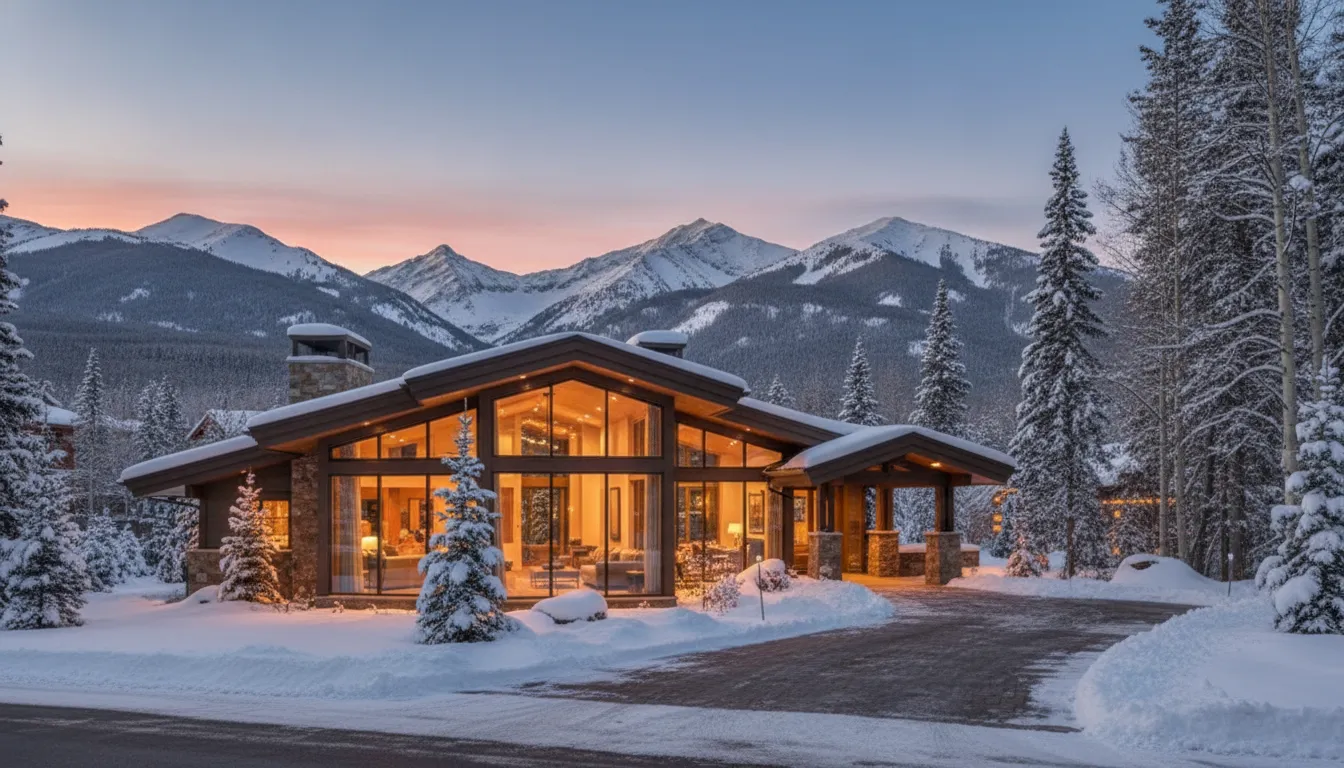


Buying a second home in Deer Valley means navigating complex jumbo loan requirements that differ from standard mortgages. Luxury buyers in Summit County face higher standards for credit scores, down payments, and cash reserves when financing a resort property above the conforming loan limit.
Jumbo loan requirements for a Deer Valley second home typically demand a 700+ credit score, 10-20% down payment, and 6-12 months of cash reserves. Summit County's 2026 conforming limit of $1,149,825 means most properties in the area need jumbo financing. CrossCountry Mortgage (NMLS #3029) specializes in these complex transactions for out-of-state luxury buyers.
Understanding these requirements before you start house hunting gives you a clear advantage in Summit County's competitive luxury market. This guide covers what you need to know about credit standards, down payment tiers, reserve requirements, and alternative programs for self-employed buyers.
A jumbo loan for a Deer Valley second home requires meeting stricter standards than a primary residence loan. Lenders evaluate credit scores, down payment size, debt-to-income ratios, and cash reserves more rigorously because these larger loans stay on their books.
A jumbo loan is a mortgage that exceeds the conforming loan limits set by the Federal Housing Finance Agency (FHFA). For 2026, the standard limit for most areas is $832,750. In high-cost regions like Summit County, this limit goes up to $1,149,825. Because homes in luxury ski resort towns often cost several million dollars, most buyers need jumbo loan programs to finance their purchase.
The FHFA sets higher limits for areas where home prices exceed the national average. In Summit County, Utah, the 2026 conforming limit is $1,149,825. Any loan amount above this figure qualifies as a jumbo loan. With median home prices in Deer Valley ranging from $4.2 million to $12 million, nearly all buyers in this market need jumbo financing to complete their purchase.
You can use jumbo loans for a primary home, a second home, or an investment property. While the basics are similar, a second home carries higher jumbo loan requirements than a primary residence. Lenders may ask for a larger down payment or more cash reserves to ensure you can handle two mortgage payments simultaneously. According to Bankrate, lenders treat second homes as higher risk because borrowers may prioritize their primary residence during financial stress.
Key takeaway: Summit County's conforming limit of $1,149,825 means any property above this threshold requires jumbo financing with stricter qualification standards than a standard mortgage.
Most lenders require a minimum credit score of 700 for a second home jumbo loan in Deer Valley. Borrowers with scores of 760 or higher qualify for the best terms, including lower down payment options and more favorable interest rates.
Credit scores play a critical role in jumbo loan approval. Because lenders keep these large loans on their own books rather than selling them to Fannie Mae or Freddie Mac. They set strict credit requirements to manage their risk exposure. Rodrigo Ballon at CrossCountry Mortgage helps buyers navigate these jumbo loan programs to find solutions that match their credit profile.
Most lenders need a credit score of at least 700 for a second home jumbo loan. Some programs accept a 680 score with a larger down payment, though these often carry higher rates. Data from Chase shows that the average jumbo loan borrower has a 785 FICO score, significantly higher than the 750 average for standard loans.
For high-value properties in areas like Empire Pass or Deer Crest, the bar rises further. Loans over $2 million typically require a minimum score of 720. Meeting these thresholds helps your application move smoothly through underwriting.
| Credit Score | Typical LTV | Down Payment | Rate Impact |
|---|---|---|---|
| 760+ | 85-90% | 10-15% | Best available rates |
| 720-759 | 75-80% | 20-25% | Standard rates |
| 700-719 | 70-75% | 25-30% | Higher rates |
| 680-699 | 65-70% | 30-35% | Limited options, higher rates |
Key takeaway: A credit score above 760 unlocks the best jumbo loan terms for Deer Valley second homes, including lower down payments and competitive interest rates.
Down payment requirements for second home jumbo loans in Deer Valley range from 10% to 30%, depending on loan size and credit profile. Most buyers should plan for 20% down to access the best rates and terms available.
A second home in Deer Valley represents a significant investment, and the down payment reflects that scale. Most jumbo loan programs for second homes require more cash upfront than standard loans. Lenders typically look for 10% to 20% down, with the exact amount depending on loan size, credit score, and property type.
For loans under $2 million, some programs offer 10% down with a 720+ credit score. As the purchase price increases, so does the cash requirement. Buyers financing homes between $2 million and $3 million should plan for 15% down. For loans from $3 million to $5 million, lenders often require 20% to 25% down to offset their risk.
Putting 20% down remains the sweet spot for luxury home financing. This level of equity typically unlocks the best rates and the widest selection of lenders. On a $3 million home in Deer Valley, 20% down equates to $600,000, which helps lower monthly payments and builds immediate equity.
Some jumbo programs allow as little as 5% down with no mortgage insurance for loans up to $2 million. These programs are rare but valuable for buyers who prefer to keep capital liquid. They work well for high-income earners who want to deploy cash elsewhere rather than tying it up in a down payment.
Self-employed buyers also have flexible options. Bank statement programs can qualify you for a luxury home with 10% down, even without tax returns. Many Summit County business owners use these programs. For all mortgage transactions, the Consumer Financial Protection Bureau recommends reviewing all costs before signing.
Key takeaway: Plan for 20% down on a Deer Valley second home to access the best jumbo loan rates. Self-employed buyers can use bank statement programs with as little as 10% down.
Lenders typically require 6 to 12 months of cash reserves for a second home jumbo loan in Deer Valley. For loans exceeding $2 million, reserve requirements can reach 12 to 18 months of total housing costs.
Lenders view second homes in resort towns like Deer Valley as higher risk than primary residences. To mitigate this risk, they require cash reserves , liquid assets remaining after your down payment and closing costs. For most luxury purchases, you must demonstrate the ability to cover principal, interest, taxes, and insurance (PITI) for a specified period.
For a standard second home jumbo loan, most lenders require 6 to 12 months of PITI reserves. If your loan exceeds $2 million, the requirement often jumps to 12 to 18 months. This ensures you can maintain payments even if your income fluctuates or the property sits vacant for a season.
On a $4 million Deer Valley property, monthly PITI might range from $22,000 to $25,000. This means you could need between $132,000 and $450,000 in liquid cash after closing. You can learn more about these requirements in our guide to jumbo loan cash reserve requirements.

Lenders use specific tiers based on loan amount and credit profile. With a 720 credit score, you might need 12 months of PITI for loans between $417,000 and $1 million. As the loan grows, so does the reserve requirement. Loans from $1 million to $1.5 million often require 18 months, while loans up to $2 million may need 24 months. For loans between $2 million and $2.5 million, some lenders require up to 36 months of reserves.
Key takeaway: Reserve requirements scale with loan size. Expect 6-12 months of PITI for standard jumbo loans and 12-36 months for loans exceeding $2 million. Rodrigo Ballon at CrossCountry Mortgage can help you structure your assets to meet these requirements efficiently.
Most jumbo loan programs for second homes cap the debt-to-income ratio at 43%. Higher DTIs up to 50% may be possible with compensating factors such as large cash reserves, a high credit score, or a substantial down payment.
Lenders scrutinize your debt-to-income (DTI) ratio closely when you finance a luxury second home. This figure represents how much of your gross monthly income goes toward debt payments. For a jumbo loan debt-to-income ratio, most banks want 43% or lower. This cap helps ensure you can manage two housing payments alongside other obligations.
Most jumbo programs for secondary residences set a hard limit at 43% DTI. However, your credit score influences what lenders allow. For example, with a 760 FICO score and a higher loan-to-value request, the limit may tighten to 36% to reduce lender risk. Some jumbo programs allow DTIs up to 45% or even 50% with compensating factors like substantial cash reserves or a large down payment.
When you apply for a jumbo loan in Summit County, the lender counts all monthly obligations. This includes the mortgage, tax, and insurance payments for both your primary residence and your new second home. They also add minimum monthly payments on credit cards, car loans, student loans, and other lines of credit. Keeping non-housing debt low before applying helps you stay under the DTI limit for a large loan.
Key takeaway: Target a DTI of 43% or lower for a Deer Valley second home jumbo loan. Higher ratios require compensating factors like extra reserves or a larger down payment.
Yes. Self-employed buyers can qualify for Deer Valley jumbo loans using bank statement programs that evaluate 12 to 24 months of deposits instead of tax returns. These programs offer loans up to $7 million with as little as 10% down.
Many luxury home buyers in Park City and Deer Valley own their own businesses. An estimated 30% of buyers in this market are entrepreneurs or self-employed professionals. Traditional banks often turn these buyers away because tax returns fail to reflect their true cash flow. Rodrigo Ballon at CrossCountry Mortgage (NMLS #3029) specializes in helping self-employed clients secure second home financing.
Most big banks use your tax returns to determine loan eligibility. They look at net income after business deductions. For many owners, tax write-offs are smart strategies, but they can make income appear lower than it actually is. This creates a high DTI ratio on paper, even for wealthy buyers. As a result, qualified entrepreneurs find themselves locked out of conventional jumbo financing.
Bank statement programs solve this problem. Instead of tax returns, lenders review 12 to 24 months of personal or business bank deposits to verify income. This approach captures your true cash flow and makes it easier to meet the strict jumbo loan requirements for high-value resort properties.
Bank statement jumbo loans are available for amounts from $3.5 million to $7 million. Many programs allow down payments as low as 10% and do not require private mortgage insurance. These terms apply whether you are buying a primary residence, a second home, or an investment property in Summit County.
Key takeaway: Self-employed buyers should explore bank statement jumbo loans. These programs qualify you based on actual cash flow rather than tax-return income, making Deer Valley second home financing accessible even with complex income structures.
Deer Valley's luxury market is experiencing strong growth, with 2025 sales volume reaching $3.27 billion, up 36.6% from 2024. With median home prices between $4.2 million and $12 million, jumbo financing is essential for most buyers.
Deer Valley remains one of the most desirable luxury real estate markets in the western United States. The local market grew substantially in 2025, with total sales volume in Park City hitting $3.27 billion, a 36.6% increase year over year. Homes in Deer Valley typically sell for between $4.2 million and $12 million, making Deer Valley luxury financing a critical component of most purchase transactions.
The high-end segment has driven much of this growth. Homes priced above $2.5 million saw a 38% increase in units sold and a 50% increase in total dollar volume. This surge reflects growing demand for second homes and investment properties in Summit County's premier ski destination.
While Deer Valley accounts for 46% of all ski property sales in the region. And over 60% of luxury sales close in cash, that leaves approximately 40% of buyers who choose to finance. Even affluent buyers often prefer to finance rather than tie up millions in a single asset. Loans allow them to deploy capital across other investments while enjoying their Deer Valley retreat.

Approximately 41% of Deer Valley housing is used for short-term rentals, creating income potential for second home owners. Some lenders may factor projected rental income into your application. According to MortgageDepot, second home purchases have increased more than 50% in the last three years nationwide.
Key takeaway: Deer Valley's surging luxury market makes it essential to have your financing pre-arranged. With limited inventory and competitive bidding, a pre-approved jumbo loan gives you a decisive advantage.
Most jumbo loan requirements for second homes include a credit score of 700 or higher. A down payment of 10% to 20%, and 6 to 12 months of cash reserves. Since these loans exceed Summit County's conforming limit, lenders set their own standards for debt-to-income ratios and asset verification.
Yes. Interest rates for second home jumbo loans are typically 0.25% to 0.50% higher than primary home rates. This premium reflects the additional risk lenders take on when a borrower manages two mortgage payments. Bankrate reported jumbo rates averaging 6.54% in late 2025 compared to 6.28% for standard loans.
The 2026 standard limit is $832,750, but Summit County qualifies as a high-cost area with a $1,149,825 ceiling. Since most Deer Valley homes sell for well over $4 million, nearly all buyers need jumbo loans. You can verify current limits on the FHFA website or speak with Rodrigo Ballon at CrossCountry Mortgage (NMLS #3029).
Yes. Self-employed buyers can use bank statement programs that review 12 to 24 months of deposits instead of tax returns. These programs offer loans up to $7 million with as little as 10% down. This option works well for business owners in Park City who have strong cash flow but complex tax filings.
Most lenders require a minimum credit score of 700 for a second home jumbo loan. A score of 760 or higher unlocks the best terms, including lower down payments and better rates. For loans over $2 million, expect a minimum of 720. Your credit score directly affects your loan options and interest rate.
The Deer Valley luxury market moves quickly, and properties in premier locations like Deer Crest. Empire Pass, and Silver Lake Village often receive multiple offers within days of listing. Having your jumbo loan pre-approved before you start touring homes gives you a significant advantage. You will know exactly how much you can borrow, which properties fit your budget, and you can make a confident offer when the right home appears.
Delaying your financing search in this competitive market can mean losing your ideal property to a buyer who is already pre-approved. Starting the process now positions you to move fast when you find the perfect Deer Valley second home.